OAU Workshop Illuminates Pathways for the Sub-Officers’ Cadre in Evolving University Landscape
November 15, 2025 2025-11-15 15:28OAU Workshop Illuminates Pathways for the Sub-Officers’ Cadre in Evolving University Landscape
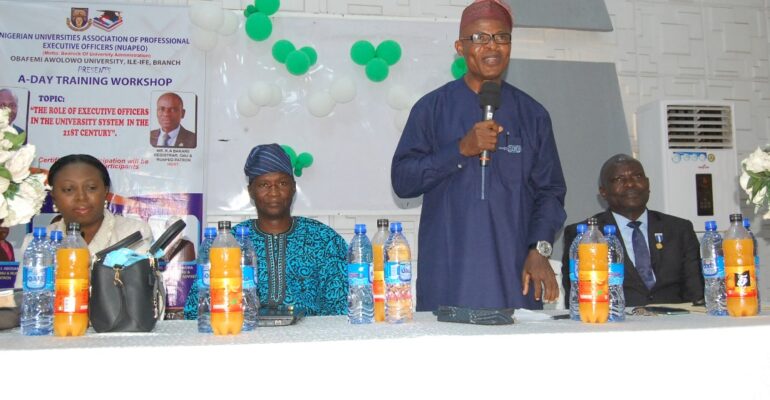
Now that Universities grapple with the inexorable forces of globalization, technological disruption, and resource scarcity, Obafemi Awolowo University (OAU) has held a pivotal one-day training workshop that dissected the evolving role of Universities’ staff in the Executive cadre in 21st-century academia. Organized by the OAU branch of the Nigerian Universities Association of Professional Executive Officers (NUAPEO), the event drew administrators from across the institution to explore themes of career progression, institutional authority, and future prospects amid profound systemic shifts.
The workshop, themed “The Role of Executive Officers in the University System in the 21st Century,” explored the indispensable function of these officers as the “bedrock” of Universities’ administration – a cadre often overshadowed yet vital to the tripartite mission of knowledge generation, dissemination, and application. The gathering blended historical reflection with forward-looking strategies, evoking John Henry Newman’s timeless vision of Universities as “universe cities” – hubs of intellectual collision and safe speculation.
In his address, the Registrar, Mr. Kamardeen Adetunji Bakare, represented by Mr. Vincent Ohalete, the Director of Personnel Affairs, articulated a vision for administrative excellence, framing executive officers as the architects of institutional resilience. “In the labyrinth of 21st-century higher education, where knowledge economies demand agility and foresight, executive officers are not mere functionaries but the synaptic connections that bind academia’s neural network,” Ohalete remarked. “They must embody a paradigm of adaptive intelligence, transforming challenges like inadequate resources and declining administrative regard into opportunities for innovative governance that propels our universities toward global eminence.”
The Registrar further echoed this profundity with a nuanced reflection on administrative evolution. Bakare, through his proxy, emphasized the historical trajectory from expatriate-dominated colonial systems to indigenous empowerment, drawing parallels to the 1942 Bourdillon Commission that catalyzed Nigerian inclusion in administrative ranks. “The executive officer’s mantle is a dialectic of commitment and responsibility, where rights derived from statutes intersect with roles that sustain the Universities ethical core,” he posited. “In this digital age, their fluency in technology and critical thinking is not optional but existential, ensuring that our institutions remain not just repositories of knowledge but crucibles for societal transformation.”
The intellectual centerpiece was the keynote by Dr. Adeduntan Segun-Olasanmi, Acting Executive Director of the University Advancement Office, titled “The Pathways, Powers, and Prospects of an Executive Officer in 21st Century University Administration.” Honored with an award prior to her presentation, Segun-Olasanmi deconstructed the theme through a PRR Framework – Powers, Rights, and Roles – rooted in University laws and schemes of service. She highlighted realities such as burgeoning student populations, technology-driven operations, and stiff global competition, urging a “paradigm shift” toward competencies like system thinking, digital agility, and a penchant for excellence.
Engaging participants interactively, Dr. Segun-Olasanmi projected a QR code for an online poll on career pathways, revealing diverse entry points into the cadre from Assistant Executive Officer to Chief Executive Officer. She outlined critical skills – from problem-solving and process facilitation to ethical legacy-building – and invoked inspiring aphorisms: “We are what we repeatedly do. Excellence, then, is not an act but a habit,” and “Leaders don’t create followers; they create more leaders.” Her discourse painted executive officers as “engine rooms” of administration, supportive of research, teaching, and community service while driving innovations.
Preceding the keynote, Mr. Kabiru Fasola, a revered voice and high ranking staff in the cadre, delivered a compelling talk on interpersonal dynamics, stressing the need for flexibility, positive attitudes, and teamwork. “Executive officers permeate every unit, serving as ambassadors of the Vice-Chancellor,” Fasola noted, advocating for adaptability in leadership transitions and diverse tasks.
The programme also featured goodwill messages, a Q&A session, and panel discussions that fostered robust dialogue. Certificates of Participation were awarded to attendees, with the University Bursar, Mrs. Olutoyin Abogan, represented by Mr. Jimmy Adedoyin, a Deputy Bursar, delivering closing remarks that commended the organizers and reiterated the imperative of continuous professional development.
As Nigeria’s higher education sector navigates fiscal constraints and calls for reform, this NUAPEO workshop emerges as a beacon, reminding stakeholders that administrative prowess is the unsung linchpin of academic excellence. With echoes of Newman’s “light of the world,” it calls for a renaissance in Universities governance, where staff members in the executive cadre rise as stewards of progress.